Wolf
Independent Wolf cooking-appliance repair in St. Johns County
Wolf builds cooking appliances and nothing else. That narrows the diagnosis usefully, and it puts the whole of the water story on the steam side of the line.
Independent Multi-brand St. Johns County, Florida
Monday – Friday 8:00am – 6:00pm $80 diagnostic
Wall & steam ovens
A conventional wall oven fails mechanically and predictably. A steam oven adds a whole second machine behind the cavity wall, with its own way of going wrong.
How this appliance actually fails
A wall oven fails as heat control or as a door. A drifted sensor is consistently wrong rather than erratic; a weakened hinge lets the door sit proud of the seal, so the oven leaks heat and runs long compensating. Owners describe both as not heating properly, and they are entirely different repairs.
What people call us about
Wall ovens and steam ovens sit in the same cabinet stack and fail for completely different reasons. Sorting which one you are describing is the first thing that happens on the phone, because in St. Johns County the steam side has a local cause and the conventional side does not.
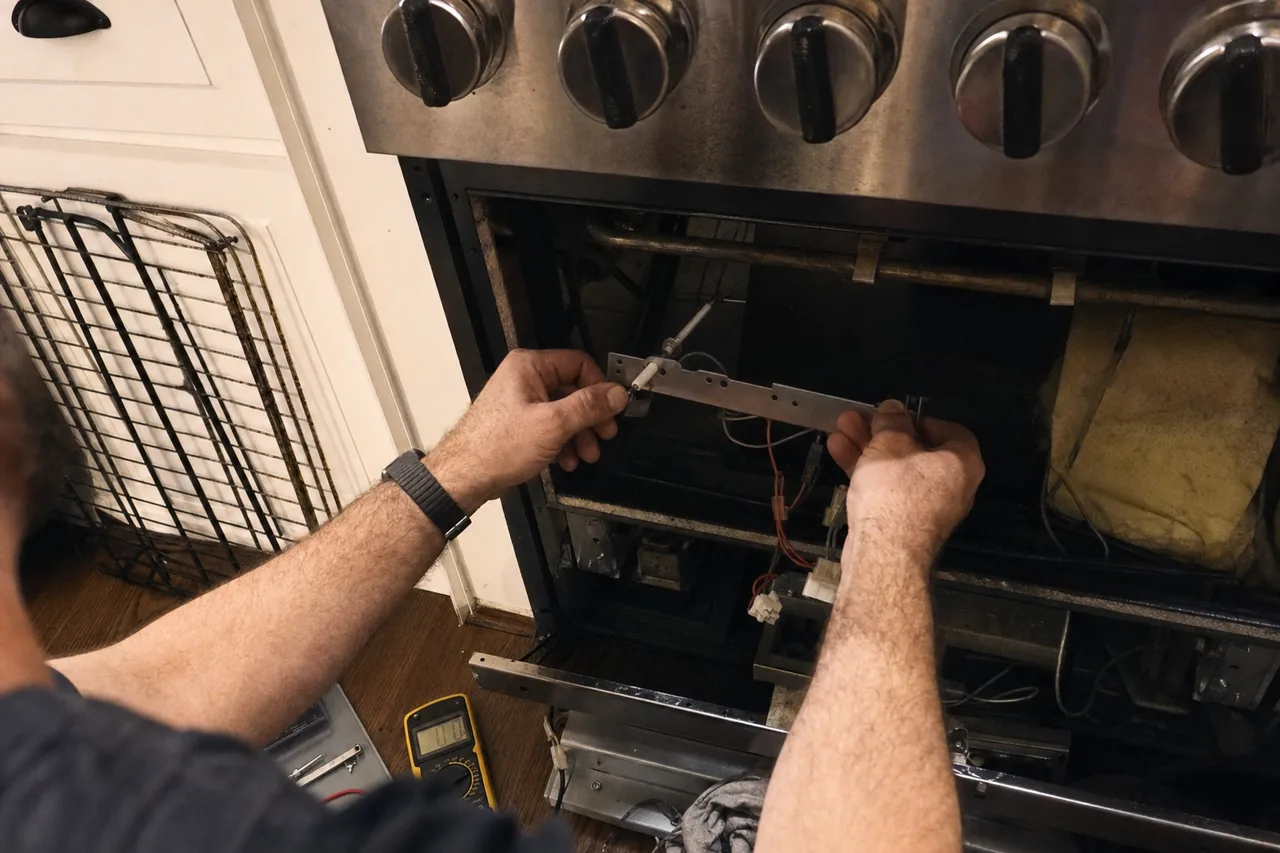
These fail mechanically and predictably: bake and broil elements, the cavity temperature sensor, the door hinge and seal, the cooling fan, the convection motor, and the control board.
The two that get misread most often are the sensor and the door. A sensor that has drifted produces an oven that is consistently wrong rather than erratic, and it is measurable in one visit against a reference. A hinge that has weakened lets the door sit a hair proud of the seal, so the oven leaks heat continuously and runs long trying to compensate. Owners describe both as “the oven is not heating properly”, and they are entirely different repairs.
Preheat time is the most useful thing a homeowner can report. If a preheat that used to take twelve minutes now takes twenty, you have given us a measurement, and measurements are worth more than adjectives on this appliance.
In a double stack, a fault on one cavity and not the other is diagnostically useful — it rules out the supply and points at that cavity’s element, sensor or relay.
A combi-steam oven is a conventional oven with an entire water-handling machine built in behind the cavity: a reservoir or a plumbed feed, a pump, a level sensor, a generator with its own heating element and thermostat, a path into the cavity, and a drain. Nearly every steam-specific complaint is one of those components rather than the oven itself.
The complaint we hear is almost always the same sentence — there is less steam than there used to be, or it takes longer to arrive — and that sentence covers at least four different faults. The pump may not be delivering. The level sensor may be reporting a reservoir as empty when it is not, or as full when it is not. The generator element or its thermostat may have degraded, so the same energy input produces less steam. Or the path into the cavity may be restricted, in which case the generator is working perfectly and the steam is not arriving where you can see it.
Those separate on measurement rather than on inspection: temperature at the generator, continuity and resistance on the element and its sensor, and whether the reservoir is actually drawing down at the rate the cycle should consume. A reservoir emptying faster than the cycle explains is a leak or a drain fault rather than a steam fault, and it is worth catching early, because the water is going somewhere.
Access is its own consideration on this appliance. A wall oven in a stack is heavy and comes out onto a support at the height it already sits at rather than down to the floor, because lowering it and lifting it back is how doors get twisted and cabinetry gets marked. On a plumbed machine the supply shut-off is frequently behind the appliance that has not been moved yet. Both are questions we would rather ask on the phone than discover halfway through.
One piece of advice that costs nothing and genuinely works: where the machine takes a fillable reservoir, fill it with distilled water rather than from the tap. It is the cheapest maintenance decision available on this appliance and it is the one most often skipped.
Northeast Florida sees roughly 68 thunderstorm days a year. Oven control boards are frequently the casualty, and rarely on the day. A board degraded by a surge in July commonly fails in the autumn, with the owner reasonably convinced nothing happened. We will not pretend to prove causation on a bench, but the pattern across a service area this size is real, and panel-level surge protection on a hardwired oven is worth the money.
Flat $80 diagnostic, credited toward the repair. Written estimate before any work begins. Genuine OEM parts, 90 days on labor, 365 days on parts.
What repairs run
The visit is $80 flat and comes off the bill. What the repair costs depends on which part failed, so these are ranges, not quotes.
| Repair | Typical range |
|---|---|
| Convection fan or motor | $260–$670 |
| Oven thermostat or temperature sensor | $190–$550 |
| Electronic control board | $400–$990 |
| Igniter, spark module or surface element | $190–$520 |
| Diagnostic visit, credited to the repair | $80 |
Parts are itemised on the written estimate, and nothing is fitted before you have approved the figure.
Questions
Related
Wolf
Wolf builds cooking appliances and nothing else. That narrows the diagnosis usefully, and it puts the whole of the water story on the steam side of the line.
Thermador
Thermador is the broadest line we work on, which means one house can have four Thermador appliances failing for four unrelated reasons.
Viking
Viking Range builds professional-style kitchen equipment, and the Viking in this county tends to be twenty years old and still worth keeping — which makes parts availability the first question.
Miele
Miele builds the most fully integrated kitchen line we work on, which makes access and correct part identification matter more here than on any other make.
Bosch
Bosch dishwashers dry by condensation rather than with an element in the tub, and that one design decision changes what a drying complaint actually means.
Customer feedback
Rated 4.4 out of 5 across 100 customer reviews. Each is one visit, described by the person who paid for it.
Filed under this appliance type, so every entry here is a visit to one.
The oven would preheat and then drift down by a long way during a roast. He found the sensor reading high once hot, replaced it and ran a long calibration. He also spotted a seal beginning to go and quoted it separately.
Marisol T.2026-02-05
The convection fan had developed a rattle at temperature. He replaced the motor and the rear baffle it had been touching, which cured the noise. It needed a second trip because the baffle was not on the van.
Georgiana P.2025-10-02
Ours ran warm overnight with the door shut, and the interior lamp never went out. He replaced a switch in the door that had stuck closed, then corrected the hinge alignment letting it sit proud. Simple once somebody looked.
Callum W.2026-09-05
Terms
Written estimate before any work begins. 90 days on labor, 365 days on parts, genuine OEM parts.