Wolf
Independent Wolf cooking-appliance repair in St. Johns County
Wolf builds cooking appliances and nothing else. That narrows the diagnosis usefully, and it puts the whole of the water story on the steam side of the line.
Independent Multi-brand St. Johns County, Florida
Monday – Friday 8:00am – 6:00pm $80 diagnostic
Ranges & cooktops
Cooking appliances never meet the water supply, so their failures come from ignition, heat control, cooling airflow and the coastal and storm environment.
How this appliance actually fails
Cooking appliances fail as ignition and flame sensing, as heat control, or as cooling. The three present similarly and separate quickly. A burner that keeps clicking has already lit, a burner that drops out at simmer is a valve, and an induction element that quits under load is thermal.
What people call us about
A range is the one appliance in the kitchen with no plumbed connection at all, which strips a whole family of causes out of the diagnosis before it starts. What is left divides cleanly into three: getting the fuel lit and knowing that it is lit, holding a temperature accurately, and getting rid of heat the appliance is not using. Two local conditions act on those — salt in the air on the coast, and roughly 68 thunderstorm days a year across northeast Florida — and one purely local habit does as much damage as either: cabinet airflow compromised by work done after the appliance was installed.
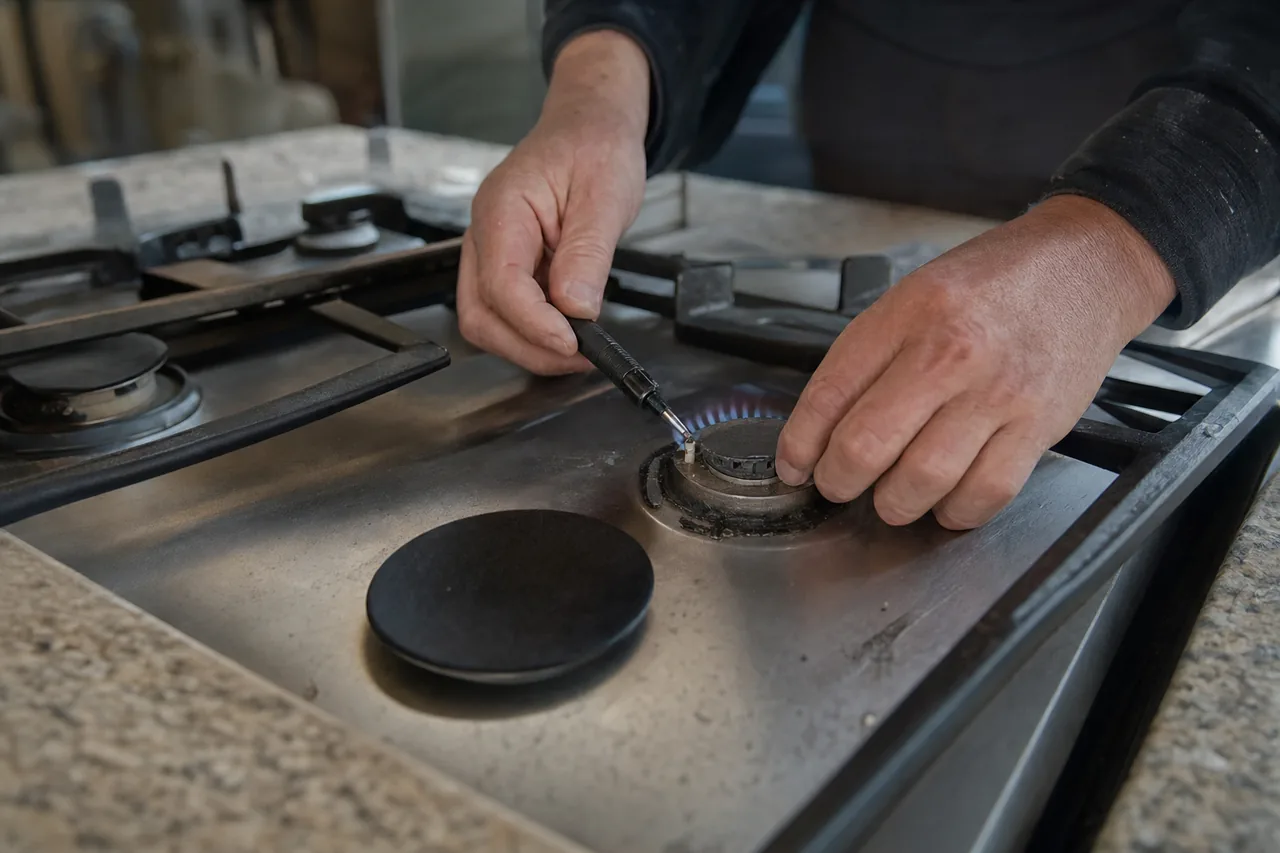
A burner that keeps clicking after it lights is not failing to ignite. It has ignited and the control is not receiving confirmation, so it keeps sparking. Nine times in ten the burner cap is seated a fraction off, or a boil-over has blocked the ports nearest the sensing point, or the igniter is damp. That is a cleaning and seating job.
A burner that will not light at all while its neighbours do is the igniter, its lead, or the connection behind it. On the coast — Ponte Vedra Beach 32082 and the older houses near the water in St. Augustine — the corrosion story applies: salt-laden air attacks the igniter tip and the terminal behind it, and the same range four miles inland goes years longer between replacements.
A burner that lights and then drops out at the simmer setting is not an ignition fault at all. It is the low-flame setting, the orifice, or the valve. Chasing the igniter on that symptom wastes a visit.
Induction elements fail by shutting down, not by weakening. An element that works from cold and stops after fifteen minutes under a heavy pan has hit a thermal cutout, and the cause is nearly always cooling: the intake beneath the cooktop blocked by a drawer insert, the cavity closed in by a cabinet modification after installation, or a slowing fan. We check airflow before we quote a board, because the board is often perfectly good and gets replaced into the same overheating environment.
Coastal kitchens add the second cause. Salt reaches the power board’s connections through the same ventilation the board depends on, and corrosion there produces intermittent behaviour that looks like a random fault.
Almost nobody notices this until the baking changes. An oven twenty degrees off does not announce itself; a cook who has used the same oven for six years announces it. The causes are the sensor, the element, or the control’s calibration, and all three are measurable in one visit. If the browning is uneven side to side rather than simply wrong overall, the convection fan or one element is the more likely answer.
Doors matter more than people expect. A hinge spring that has weakened lets the door sit a millimetre proud of the seal, and the oven then runs long trying to hold temperature against a continuous leak. That reads as a heating fault and is a hinge.
Northeast Florida runs roughly 68 thunderstorm days a year. Control boards rarely die during the storm. They die weeks later, having been degraded by a surge that did not destroy them outright, and the owner has no reason to connect a September failure with a July storm. When we see a board fail on an appliance four or five years old with no other cause, we say so, and we recommend surge protection at the panel rather than at the outlet, because a hardwired range has no outlet to protect.
Flat $80 diagnostic, credited toward the repair. Written estimate before any work. Genuine OEM parts, 90 days on labor, 365 days on parts. Scheduled appointments Monday to Saturday.
What repairs run
The visit is $80 flat and comes off the bill. What the repair costs depends on which part failed, so these are ranges, not quotes.
| Repair | Typical range |
|---|---|
| Igniter, spark module or surface element | $190–$520 |
| Oven thermostat or temperature sensor | $190–$550 |
| Electronic control board | $400–$990 |
| Diagnostic visit, credited to the repair | $80 |
Parts are itemised on the written estimate, and nothing is fitted before you have approved the figure.
Questions
Related
Wolf
Wolf builds cooking appliances and nothing else. That narrows the diagnosis usefully, and it puts the whole of the water story on the steam side of the line.
Thermador
Thermador is the broadest line we work on, which means one house can have four Thermador appliances failing for four unrelated reasons.
Viking
Viking Range builds professional-style kitchen equipment, and the Viking in this county tends to be twenty years old and still worth keeping — which makes parts availability the first question.
Bosch
Bosch dishwashers dry by condensation rather than with an element in the tub, and that one design decision changes what a drying complaint actually means.
Customer feedback
Rated 4.4 out of 5 across 100 customer reviews. Each is one visit, described by the person who paid for it.
Filed under this appliance type, so every entry here is a visit to one.
Our rangetop grill module had lost its even heat and the grates were pitting. He replaced the burner and the corroded grate set, explained how close we are to the water, and set a cleaning routine that has kept it right.
Tiberius O.2026-09-15
Knobs on the rangetop had become stiff enough to need two hands. He stripped and regreased the valve stems, replaced one that had scored, and it is usable again. He had to order the scored valve, so it took two visits.
Corbinian F.2026-02-24
The bridge zone stopped recognising anything wider than a saucepan. He tested the coils individually, found one detection sensor out of range and replaced the pair so they match, then checked the whole top with our own pans.
Seraphine R.2026-01-27
Terms
Written estimate before any work begins. 90 days on labor, 365 days on parts, genuine OEM parts.